Tatsu’s Newsletter
Tatsu’s Newsletter Podcast
The Iranian Grapefruit Problem
0:00
-24:39

The Iranian Grapefruit Problem

What "Boots on the Ground" in Iran Actually Looks Like

This article took real research: nuclear geology, military logistics doctrine, airborne division operational history, declassified weapons assessments, and a framework from the professor who has advised every White House since 2001. It is designed to take you from "boots on the ground" (the cable news soundbite you keep hearing) to a detailed, ahead-of-real-time analysis of what a ground operation in Iran actually looks like, why it was set up to fail before it started, and what comes after. Bloomberg charges $35 a month for market coverage. The Financial Times charges $42. This is $8 a month, $80 a year. Pennies per article for analysis that is ahead of the news cycle, not behind it.

Share this preview with others who should see this.

Share

On March 6, the U.S. Army cancelled a headquarters training exercise for the 82nd Airborne Division.[1] The command element was ordered to remain at Fort Liberty, North Carolina, instead of continuing to a planned rotation in Louisiana. The Pentagon said no deployment orders had been issued. They also refused to take ground troops off the table.

The 82nd Airborne is the Global Response Force: the only division in the U.S. Army that maintains a brigade combat team ready to deploy anywhere on Earth within 18 hours.[2] You do not cancel a training exercise to keep them "ready" unless readiness means something specific. On March 12, Robert Pape, a University of Chicago professor who has advised every White House since 2001 and spent three decades building the curriculum that trains the Air Force for exactly this kind of war, told Diary of a CEO that he gives 75% odds the United States will send ground forces into Iran.[3] His reason is simple: we still do not know where the enriched uranium is, and we have run out of things to bomb.

Everyone is debating whether stage 3 happens. Nobody is explaining what it looks like when it does, or why everything America has done in Iran so far made it nearly impossible to succeed.

Full investigation below. $8/month for analysis that's ahead of the news cycle.

The Wrong Order

Here is the argument you will not hear on cable news: the entire campaign was sequenced backwards.

If the endgame was always to secure Iran's enriched uranium (the only outcome that actually resolves the nuclear question), then ground forces needed to go in first, with air support. Instead, the United States did the opposite. Operation Midnight Hammer hit the nuclear facilities in June 2025. Operation Epic Fury targeted the regime in February 2026. Both operations gave Iran exactly what it needed: time and incentive to scatter its most dangerous material across 1.6 million square kilometers of mountain, desert, and tunnel networks.

Midnight Hammer sent seven B-2 Spirit stealth bombers from Whiteman Air Force Base carrying fourteen GBU-57 Massive Ordnance Penetrators.[4] Twelve of them were dropped on Fordow alone, targeting two primary ventilation shafts in a "drilling" methodology: the first weapon removes the heavy concrete defensive caps, and the subsequent five enter the open shaft at over 1,000 feet per second.[4] The facility was assessed as "functionally destroyed," meaning the centrifuges and support infrastructure were likely pulverized. But here is the problem that should have been obvious from the start. Satellite imagery showed trucks moving material out of Fordow two days before the strikes.[3] As Pape observed on the podcast: "I don't think they're moving out the popcorn."

Epic Fury launched eight months later, killing the Supreme Leader along with 20 to 30 other senior leaders. By then, Iran had dispersed its stockpile of 60% enriched uranium (enough for sixteen nuclear devices) across a country the size of Alaska.[5] The air campaigns did not prepare the battlefield for a ground operation. They sabotaged it. They turned a difficult problem (securing known facilities with concentrated material) into an impossible one (searching an entire nation for objects that can be moved in civilian trucks).

It is Where's Waldo, but with nukes.

And the sequencing failure goes deeper than logistics. The Supreme Leader whom Epic Fury killed, Ayatollah Khamenei, had issued two fatwas (religious edicts) against nuclear weapons.[3] Two. Those edicts died with him. His son, the new Supreme Leader, has issued no fatwa. He ran the Basij, the regime's internal security apparatus that specialized in suppressing protesters.[3] He is, by every account, significantly more aggressive than his father. The United States killed the one leader who had religious guardrails against weaponization and replaced him with someone who has every incentive to build the bomb. After all, we are already killing them. What exactly is their incentive not to?

Pape calls this the escalation trap.[6] I would call it something simpler: we bombed the buildings, gave Iran ten months to move everything that mattered, killed the moderate, promoted the hardliner, and are now contemplating sending a light infantry brigade to find with rifles what 30,000-pound bombs could not destroy. The campaign was not just poorly sequenced. It was designed, step by step, to guarantee its own failure.

Eighty Meters of Limestone

To understand why ground forces are even being discussed, you have to understand what the bombs did and did not accomplish at Fordow.

The Fordow Fuel Enrichment Plant sits at 34.88°N 50.99°E, roughly 30 kilometers north of the holy city of Qom, buried 80 to 90 meters beneath a mountain in the Zagros range.[7] This is not ordinary rock. The overburden is dense limestone and dolostone, carbonate formations with compressive strength estimated at 1.5 to 2 times that of standard reinforced concrete.[8] The mountain does not merely cover the facility. It functions as structural armor, absorbing and dispersing shockwaves from sequential detonations. Compare this to Natanz, which sits on alluvial sediments (unconsolidated sands and gravels) and is significantly more vulnerable to compression collapse.[8]

The GBU-57 Massive Ordnance Penetrator is a 30,000-pound weapon, the largest conventional bomb in the American arsenal. Twelve of them hit Fordow's ventilation shafts using the drilling methodology described above.[4] Battle damage assessments indicated the facility was functionally destroyed, but the underground chambers themselves may not have fully collapsed.[4] That distinction matters enormously for what comes next.

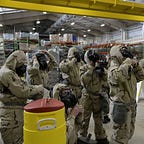
Searching those chambers would mean sending CBRN (Chemical, Biological, Radiological, Nuclear) specialist teams into a mountain that is structurally compromised by seismic shock.[9] The destruction of centrifuges fed with uranium hexafluoride gas released uranyl fluoride and hydrogen fluoride into the tunnel system, the latter being a highly corrosive acid that attacks tissue on contact.[10] Personnel would operate in full MOPP (Mission Oriented Protective Posture) gear: gas masks, chemical-resistant suits, and heavy gloves that severely degrade physical performance, communication, and visibility.[9] They would navigate dark, partially collapsed limestone corridors while scanning rubble for radioactive material.

Snapshot: Airmen, commander complete CBRN training > Dover Air Force ...

This is what "securing Fordow" actually means. Not paratroopers standing on a hilltop. Hazmat teams crawling through a poisoned mountain, inch by inch, scanning every kilogram of debris for alpha and beta radiation signatures that are blocked by a few millimeters of metal or a few centimeters of air.[11] There is no shortcut. There is no drone that does this. There is no sensor you can fly over the mountain. You need human hands, within arm's reach of the material, in the dark, in a gas mask, in a building that might finish collapsing on top of you.

The Grapefruit

Even that nightmare scenario assumes the material is still at Fordow. It almost certainly is not.

As of early 2026, Iran possessed roughly 409 to 460 kilograms of uranium enriched to 60%, a stockpile that could be refined to weapons-grade (90%) in seven to ten days.[5] The amount of weapons-grade uranium required for a single nuclear device is approximately 25 kilograms.[12] In its metal form, that is a volume smaller than a grapefruit.

A grapefruit. That is what 5,000 paratroopers would be searching for.

The material exists in three forms, each with different concealment profiles. Uranium hexafluoride is a gas used during enrichment, stored in large steel cylinders that require specialized handling and are relatively hard to hide.[13] Uranium oxide is a powder stored in standardized drums and cans, easily transported in small vehicles.[12] Uranium metal, the weaponization stage, is the nightmare scenario for any search operation because of its extreme concealability: one bomb's worth fits in a case you could carry with one hand.[12]

Iran does not need heavy convoys. Civilian vehicles and small military patrols can transport weapons quantities of uranium across the country's road networks without any observable signature.[14] Alpha and beta radiation from uranium oxide or metal cannot be detected from the air; the emissions are blocked by minimal shielding.[11] There is no satellite, no standoff sensor, and no airborne platform that can locate this material remotely. You need human beings with handheld detection equipment within arm's reach of every suspect container in a country that is 4.1 times larger than California.[15]

And the sites you would need to search extend far beyond Fordow and Natanz. The facility that rarely enters public discussion is Kuh-e Kolang Gaz La, located one mile south of Natanz in the Zagros Mountains.[5] It is deeper than Fordow, with a footprint of roughly one square mile and four entrance tunnels. That is just the one we know about. Iran's modern centrifuges (IR-6 and IR-8 models) are modular: a cascade of 164 to 174 machines fits in a small warehouse or mountain tunnel with minimal external signature.[5] In the 1990s, Iran ran covert enrichment experiments at the Kalaye Electric Company, an unremarkable building in Tehran.[5] The destruction of the two primary facilities does not kill the program. It forces the program into what Iranian military doctrine calls the Mosaic: a decentralized constellation of covert nodes that are individually small, collectively lethal, and operationally invisible.

This is not a military problem. It is a forensic scavenger hunt conducted at gunpoint, across a country the size of Alaska, for objects smaller than a grapefruit.

5,000 Paratroopers

The 82nd Airborne Division, headquartered at Fort Liberty (formerly Fort Bragg), is the U.S. Army's only division-level rapid deployment force.[2] The full division numbers roughly 20,000 soldiers. The Global Response Force brigade, the one on 18-hour alert, consists of 4,000 to 5,000 organized around three infantry battalions, a field artillery regiment with airdrop-capable M119 howitzers, a cavalry reconnaissance squadron, and a combat aviation brigade with AH-64 Apaches and UH-60 Black Hawks.[16]

They are fast. They are also lightly armed. The 82nd does not carry M1 Abrams tanks or M2 Bradley fighting vehicles.[16] Their survival depends on two things: air superiority and continuous aerial resupply. In flat terrain with a functioning logistics chain, this works. In the Zagros Mountains, at altitudes exceeding 3,000 meters where helicopter lift capacity degrades and mountain passes funnel movement into predictable chokepoints, it becomes a different equation entirely.[17]

The 82nd's operational history tells a story that planners know but policymakers ignore. In Grenada (1983), a rapid deployment to secure an airfield became a military occupation.[18] In Panama (1989), the division conducted its first combat jump since World War II and then remained for extended operations in complex urban terrain.[18] In Saudi Arabia (1990), the 2nd Brigade arrived six days after Iraq invaded Kuwait as the "vanguard" of the buildup; what started as a defensive deployment lasted through the ground war and beyond.[18] In Afghanistan, the 82nd was involved from 2001 through the final Kabul airlift in 2021, a 20-year arc from rapid counter-terrorism raids to nation-building to chaotic withdrawal.[19] In Iraq, the "limited" goal of securing WMD sites transitioned into a decade of counterinsurgency.[20]

The pattern is unbroken across seven decades. Every "limited" deployment of the 82nd Airborne expanded beyond its original mandate, not because of poor discipline, but because the act of landing creates security requirements that only more forces can fulfill. To protect paratroopers at Fordow, you need to seize a nearby airfield for resupply. To protect the airfield, you need a persistent air defense bubble. To sustain the air defense, you need CBRN and special operations units rotating in. To protect the rotation corridors, you need spoiling attacks against IRGC units moving toward the site from the surrounding mountains.[15] Each requirement generates its own requirements. Mission creep is not a failure of planning. It is a structural inevitability.

"Airpower alone has never produced positive regime change. I don't mean rarely. I mean never." Robert Pape, February 28, 2026[21]

The Math

A brigade combat team is designed to operate for up to seven days without a ground line of communication.[22] After that, everything depends on the air bridge.

The logistics requirements for 5,000 soldiers in high-altitude, contested mountain terrain are worth spelling out because they illustrate why "limited" is a fiction. Water: 15 to 20 gallons per soldier per day, all of it flown in because the Zagros highlands have virtually no potable sources.[22] Fuel: more than 10,000 gallons per day for heating, communications equipment, and aviation.[23] Ammunition: 50 to 80 tons per day in a high-intensity combat environment.[22] Medical: a Level II field facility with a 72-hour supply limit requiring constant resupply.[22] Every gallon, every round, every unit of blood must arrive by C-17 or C-130 at a seized airfield, then move by helicopter or light truck to the mountain position. Both the helicopter and the truck are vulnerable to Iranian air defenses and ground ambush.

Now consider where those flights originate. A ground operation at Fordow would stage from Al Udeid Air Base in Qatar and Al Dhafra in the UAE.[24] As of March 2026, both facilities are under direct Iranian attack. The IRGC has struck the Al Udeid radome with missiles and targeted UAE desalination plants with precision drones.[24] Iran's horizontal escalation strategy (striking Gulf state infrastructure to fracture the coalition) directly undermines the logistics chain that any ground operation would depend on.

Tourism accounts for 5 to 10% of GDP in these Gulf states.[3] Airports are closing. Hotels have been hit. Half a million American citizens in the region need evacuation support. As I reported in my analysis of Bahrain as the coalition's structural weak point, the pressure on Gulf state governments to restrict U.S. basing is becoming irresistible.[25] If Saudi Arabia or the UAE limits access to their airfields, the supply chain pushes back to Diego Garcia or carrier-based operations in the Arabian Sea, cutting sortie rates dramatically.[26]

With restricted basing, the 82nd Airborne at Fordow faces a supply crisis within 72 to 96 hours of landing.[23] The air bridge is not a convenience. It is the only thing keeping them alive.

The Mosaic

Iran's military doctrine was designed for this exact scenario.

The framework is called Decentralized Mosaic Defense, and it was developed specifically to counter a technologically superior expeditionary force.[15] The concept ensures that if central command in Tehran is disrupted (which it has been), regional IRGC commanders have full authority to continue the fight autonomously.[15] There is no single node to strike. The command structure regenerates the way Pape described the regime itself: pull a piece out and the matrix fills the hole, usually with something harder.

Iran fields a million men in arms, roughly equal to the entire U.S. active duty military, from a population of 92 million.[3] Of these, 150,000 to 200,000 are Revolutionary Guards, the most aggressive and best-trained component, backed by the Basij militia with millions of mobilizable members capable of neighborhood-level resistance.[27] The new Supreme Leader ran the Basij before his elevation. He knows this force intimately.

The Zagros Mountains amplify every defensive advantage. Passes funnel movement into predictable corridors. In March, those corridors are choked with snow and mud, making even light-vehicle movement treacherous.[17] Iran learned the value of this terrain during the Iran-Iraq War (1980-1988), when defensive positions in the Zagros stalled the advance of a Soviet-equipped Iraqi military that outnumbered them.[15] The fortress mentality forged in those eight years now governs IRGC doctrine.

Against the air bridge, Iran deploys Tabas surface-to-air missiles (90-kilometer range) in pop-up ambush mode: radars activate only to fire, then the launcher relocates into mountain tunnels.[28] Misagh man-portable systems are distributed to IRGC and Basij units across the countryside, threatening every helicopter and low-flying transport within range.[28] Shahed-series suicide drones operate in swarm formations designed to overwhelm the point defenses of an airborne brigade's landing zone.[28] Every road between a seized nuclear site and a staging airfield becomes a gauntlet of IEDs and anti-tank guided missiles.

And behind all of this, as I reported last week, Russian SIGINT platforms operating from Syrian bases continue to feed Iranian targeting data.[29] The Il-20M electronic intelligence aircraft and the Krasukha-4 electronic warfare system provide signals intelligence that makes Iranian air defenses significantly more lethal than their paper specifications suggest. The 82nd's helicopters and transport aircraft would fly through airspace where the enemy knows their communication patterns, flight corridors, and radar signatures, courtesy of Moscow.

The Pattern

There is a word for what happens when a great power sends a "limited" force into hostile terrain with objectives that expand on contact with reality.

Lebanon, 1982: U.S. Marines deployed to Beirut for peacekeeping. Eighteen months later, 241 of them were dead in a truck bomb and the mission was over.[30] Somalia, 1992: Operation Restore Hope launched as humanitarian food security. It ended with Black Hawk Down and a withdrawal that shaped American risk aversion for a decade.[20] Iraq, 2003: "weeks, not months" became eight years of counterinsurgency after the failure to plan for post-conflict governance.[20] Soviet Afghanistan, 1979: a low-profile stabilization mission consumed a decade, 15,000 Soviet soldiers, and contributed to the collapse of the Soviet Union itself.[31] Chechnya, 1994: Russia's "limited police action" became a street-by-street defeat in Grozny, followed by a second war that required the total destruction of the region's infrastructure to achieve what Moscow called victory.[32]

In every case, the gap between stated objective and actual timeline was measured in years, not weeks. The mechanism is always the same: the act of landing creates requirements for protection, protection requires expansion, expansion requires more forces, and more forces create more targets for a defender with home-field advantage and nowhere else to go.

Pape pointed to the Chechnya parallel specifically. When Russia assassinated the Chechen leader Dudayev in 1996 (using a missile guided to his satellite phone signal), his replacement, Shamil Basayev, launched Operation Jihad within three months.[3] Basayev's tactics were more vicious, not less. Waves of suicide attacks, massive hostage takings, and a guerrilla campaign that kicked the Russian military out of the province. The new leader had to prove he was harder than the old one. The son of the man America killed in Tehran faces the same incentive structure, with considerably more resources at his disposal.

The Real Price

While the United States weighs whether to send 5,000 soldiers into the Zagros Mountains, the audience that matters most is in Beijing.

The standoff precision guided munitions being expended over Iran are the same weapons the United States would need to defend Taiwan.[33] Tomahawk cruise missiles, JASSMs, JDAMs: these are not interchangeable with gravity bombs, and production rates are nowhere near consumption. The United States produces approximately 57 Tomahawk cruise missiles per year against a stated requirement of 1,000 per year.[33] Secretary Hegseth has publicly acknowledged the shortfall. Every missile fired at an Iranian target is one fewer missile available for the Taiwan Strait. Every interceptor expended over the Persian Gulf is one that does not protect a carrier in the Western Pacific.

Pape, who toured Chinese advanced industries for two weeks last summer (BYD factories, AI clusters in Wuhan, robotics in Shenzhen), put it directly: China would "gladly give up all of the Middle Eastern oil" to keep America pinned in the Middle East.[3] China sources approximately 20% of its energy from oil, a manageable fraction of GDP. The strategic prize of keeping America distracted, depleted, and committed to a theater 7,000 miles from the Pacific is worth far more than any disruption to petroleum markets.

Russia benefits in parallel. Putin's provision of targeting intelligence to Iran is not charity. It is leverage for a deal that trades Ukrainian security for American operational relief: stop feeding Ukraine targeting data, and Russia will stop feeding Iran.[3] Trump was on the phone with Putin before his most recent press conference. The outlines of that exchange are not hard to infer.

The architecture I have been documenting across this series (China's BeiDou navigation backbone feeding precision strike capability, Russia's Syrian SIGINT platforms providing electronic intelligence to Iranian air defenses, Iran's launcher and drone capacity executing the strikes) does not require a formal alliance.[34] It requires only aligned incentives. And the United States, through the sequencing of its own campaign, has aligned those incentives perfectly.

"If we're really running low on standoff precision weapons, Xi's just licking his chops." Robert Pape, March 12, 2026[3]

The Trap We Built

Pape's three-stage escalation trap (smart bomb success, regime change, ground deployment) is the cleanest framework available for understanding where this conflict is headed.[6] But the framework describes the trajectory. The question this investigation has tried to answer is the operational reality inside stage 3, and why the two stages that preceded it made success functionally impossible.

How do you search a poisoned mountain with CBRN teams in full protective gear, scanning rubble for radiation that can only be detected at arm's length? How do you sustain 5,000 lightly armed soldiers at 3,000 meters, supplied entirely by air, while the bases those aircraft fly from are under drone attack? How do you conduct a forensic nuclear scavenger hunt across a country 4.1 times the size of California when the object you are looking for is smaller than a grapefruit and can be moved in the trunk of a sedan?

The historical record answers clearly: you cannot do it with a "limited" force on a "limited" timeline. You can only do it by committing to a presence that grows, and grows, and grows, until you are back where you were in Iraq, in Afghanistan, in Vietnam. Winning every tactical engagement. Losing the strategic war. Burning through the munitions you need for the Pacific. Watching China build AI clusters that uplift 9 million people at a time while you search for grapefruits in the mountains.

The entire campaign was sequenced backwards. If the goal was the uranium, you go get the uranium first. With 20,000 paratroopers, with CBRN teams, with air support, before Iran has time to scatter anything. Instead, we bombed the buildings, gave them ten months to move everything that mattered, killed the one leader who had religious edicts against nuclear weapons, and promoted his more aggressive son.

The 82nd Airborne's training exercise has been cancelled. The GRF brigade sits at Fort Liberty, 18 hours from the Zagros. Pape gives 75/25 odds they go.

The trap is set. We built it ourselves.


Original, footnoted geopolitical analysis. $8/month, less than Bloomberg, ahead of the news cycle.

Leave a comment


Notes

[1] "Army Airborne moves invite speculation as U.S. plots next steps in Iran." The Washington Post, March 6, 2026. Reports on the cancellation of the 82nd Airborne's headquarters exercise and the decision to keep the command element at Fort Liberty.

[2] "82nd Airborne Division." U.S. Army. Official page for the division, describing its mission as the Army's Immediate Response Force capable of worldwide deployment within 18 hours.

[3] Robert Pape, interview on Diary of a CEO with Steven Bartlett, March 12, 2026. Pape discusses his three-stage escalation trap framework, gives 75/25 odds on U.S. ground deployment to Iran, names the 82nd Airborne specifically, and describes the intelligence failure surrounding dispersed enriched uranium. Pape has advised every White House since 2001 and built the Air Force strategy curriculum at the University of Chicago.

[4] "Everything We Just Learned About the GBU-57 Massive Ordnance Penetrator Strikes on Iran." The War Zone. Details the "drilling" methodology used at Fordow: seven B-2 bombers, fourteen MOPs, twelve on Fordow targeting ventilation shafts at over 1,000 feet per second.

[5] "Nuclear program of Iran." Wikipedia. Comprehensive overview including stockpile estimates (409-460 kg at 60% enrichment), the Kuh-e Kolang Gaz La facility south of Natanz, modular IR-6/IR-8 centrifuge capabilities, and historical covert enrichment at Kalaye Electric Company.

[6] Robert Pape, "How Iran Is Winning the Escalation War." Foreign Affairs, March 12, 2026. Pape's formal articulation of the three-stage escalation trap: tactical bombing success, regime change, and the pressure toward ground deployment.

[7] "Fordow Fuel Enrichment Plant." Wikipedia. Location coordinates, depth (80-90 meters), construction history, and IRGC base origins of the facility.

[8] "Rocks vs Bombs: Fordow and Natanz show how subsurface geology shapes survivability of underground targets." Down To Earth. Geological analysis comparing carbonate rock (limestone/dolostone) at Fordow to alluvial sediments at Natanz, with compressive strength estimates of 1.5-2x reinforced concrete.

[9] "Operationalizing CBRN Core Functions." Army Chemical Review, 2024. Describes CBRN specialist operations in contaminated environments including MOPP gear protocols, physical performance degradation, and decontamination procedures.

[10] "Nuclear geology: The mountain protecting Iran's Fordow enrichment site." Ynet News. Analysis of Fordow's geological defenses, uranium hexafluoride byproducts, and the chemical hazards created by the destruction of active centrifuge cascades.

[11] "Army Radiation Protection and Safety Programs." National Academies of Sciences. Technical assessment of alpha and beta radiation detection limitations, including the inability to detect these emissions through minimal shielding.

[12] "What Steps Must Iran Take to Construct Nuclear Weapons?" Foundation for Defense of Democracies. Details the approximately 25 kg of weapons-grade uranium required per device, physical forms of enriched material, and transport container types.

[13] "Manual on the Safe Production, Transport, Handling and Storage of Uranium Hexafluoride." International Atomic Energy Agency. Technical specifications for UF6 storage in 30B and 48Y steel cylinders, handling requirements, and transport protocols.

[14] "After the strikes, how would the US secure Iran's enriched uranium?" WFIN. Analysis of Iran's dispersal capabilities, civilian vehicle transport scenarios, and the practical challenges of locating enriched material across Iran's territory.

[15] "Iran's war doctrine revealed: Decentralized Mosaic Defence." Gulf News. Detailed description of Iran's Mosaic Defense framework, IRGC autonomous regional command authority, and how the doctrine was specifically developed to counter technologically superior expeditionary forces.

[16] "The 82nd Airborne: Immediate Response Force at Scale." Citadel/CENTCOM, March 6, 2026. Analysis of BCT structure, equipment (M119 howitzers, Javelins, light vehicles), and the division's dependence on air superiority and aerial resupply.

[17] "Iran's Second Front: Assessing the Kurdish Ground Incursions." SpecialEurasia, March 5, 2026. Terrain analysis of the Zagros Mountain region including altitude challenges, seasonal pass conditions, and funneling effects on ground movement.

[18] "Division History." 82nd Airborne Division Museum. Operational history including Grenada (1983), Panama (1989), Desert Shield/Storm (1990-91), and the pattern of rapid deployment followed by extended commitment.

[19] "History of the War in Afghanistan (2001-2021).") Wikipedia. Comprehensive timeline of the 82nd Airborne's involvement from initial counter-terrorism operations through the 2021 Kabul evacuation.

[20] "Iraq Without a Plan." Brookings Institution. Analysis of the 2003 invasion's transition from "weeks, not months" to prolonged occupation, with parallels to Somalia and Lebanon as cases of mission creep.

[21] Robert Pape, quoted on Boston radio, February 28, 2026. Statement made on the day Operation Epic Fury launched, referencing his decades of research on air power and regime change documented in Bombing to Win: Air Power and Coercion in War (Cornell University Press, 1996).

[22] "Logistics support to semi-independent operations." U.S. Army. Doctrine for sustaining a brigade combat team operating without a ground supply line, including the seven-day operational window, water/fuel/ammunition requirements, and medical resupply constraints.

[23] "Brigade Sustainment in Decisive Action Operations." U.S. Army Center for Lessons Learned. Detailed logistics calculations for fuel consumption (10,000+ gallons/day), ammunition expenditure rates, and the 16-kilometer logistics column required for sustained operations.

[24] "America's Military Buildup Around Iran: What We Know and What It Means." Middle East Forum. Overview of U.S. basing in the Gulf region including Al Udeid and Al Dhafra, IRGC strikes on these facilities, and the strategic implications of coalition fracturing.

[25] Tatsu Ikeda, "Bahrain: The First Domino," Institutional Intelligence, March 10, 2026. Analysis of interceptor depletion, Gulf state coalition fracturing under Iranian horizontal escalation, and the structural vulnerabilities of the U.S. basing network in the Persian Gulf.

[26] "U.S. Military Faces Escalating Logistical Strain in War Against Iran." Iran Press. Reports on the operational impact of restricted Gulf state basing on U.S. sortie rates and the fallback to Diego Garcia and carrier-based operations.

[27] "Invading Iran Would Be 'One of the Most Complex Military Operations in Modern History.'" 19FortyFive, March 2026. Assessment of IRGC ground forces, Basij militia mobilization capacity, and Iran's million-strong armed forces.

[28] Iran's air defense capabilities are distributed across multiple systems including the Tabas SAM (90km range, mobile pop-up deployment), Misagh-series MANPADS (distributed to IRGC/Basij units), and Shahed-series suicide drones. Sources include the GBU-57 discussion on CredibleDefense and Mehr News Agency defense coverage.

[29] Tatsu Ikeda, "Russia's Syrian Intelligence Hub." Institutional Intelligence, March 11, 2026. Investigation into Russian SIGINT platforms (Krasukha-4, Il-20M, Il-22PP Porubshchik) operating from Syrian bases and feeding targeting data to Iranian air defense networks.

[30] "United States invasion of Grenada." Wikipedia. Also covers the 1982-1984 Lebanon deployment and the October 23, 1983 Beirut barracks bombing that killed 241 U.S. Marines during a "peacekeeping" mission.

[31] "Soviet-Afghan War." Military History Wiki. Overview of the 1979-1989 Soviet intervention, originally planned as a limited stabilization mission, resulting in 15,000 Soviet casualties and contributing to the collapse of the USSR.

[32] "Lessons Learned or Mistakes Repeated? A Study of Soviet Performance in Afghanistan versus Russian Performance in the Chechen Wars." ResearchGate. Comparative analysis of Russia's Chechnya campaigns: the 1994-96 "police action" that became a defeat, and the 1999-2009 second war requiring total infrastructure destruction.

[33] Center for Strategic and International Studies (CSIS) munitions production analysis. Current Tomahawk production rate of approximately 57 per year against a stated annual requirement of 1,000, with an aggregate shortfall of $28.8 billion across precision munitions programs. Secretary Hegseth's public acknowledgment of standoff PGM depletion during the Iran campaign.

[34] Tatsu Ikeda, "China's Kill Chain: BeiDou," Institutional Intelligence, March 9, 2026. Investigation into the trilateral architecture: China's BeiDou satellite navigation feeding precision strike capability, Russian SIGINT providing electronic intelligence, and Iranian launch platforms executing strikes.

Discussion about this episode

User's avatar

Ready for more?